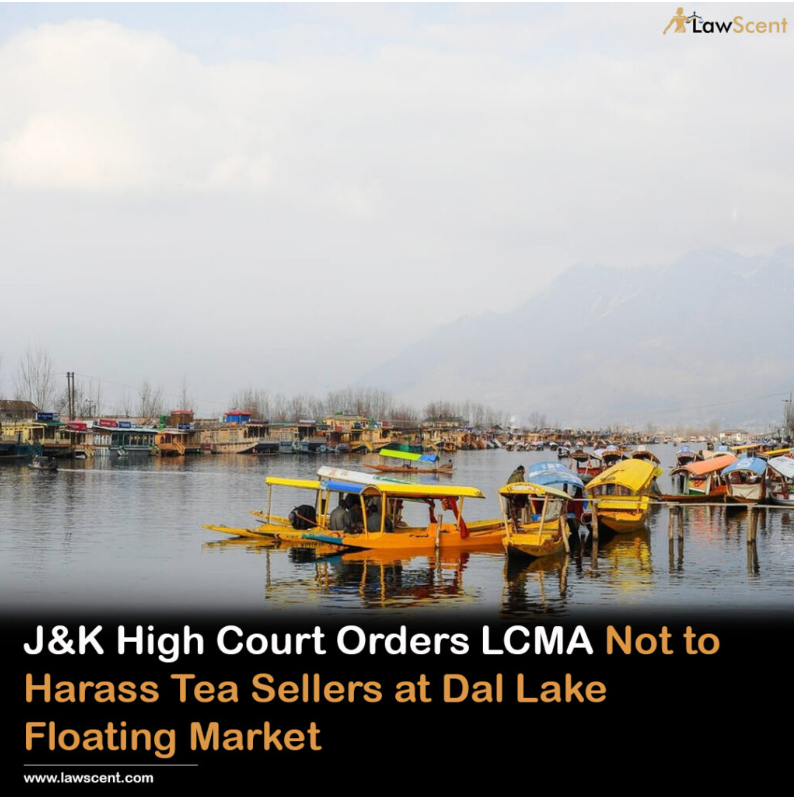
The Jammu and Kashmir High Court recently directed the Jammu and Kashmir Land Conservation and Management Authority (LCMA) in Srinagar not to harass tea sellers at the Dal Lake floating market, as long as they have valid licenses. This decision came in response to a petition filed by the partners of Zabarwan Tea Stall, who complained that LCMA officials were frequently visiting and disturbing their business.
Court Proceedings and Decision
The High Court's order was passed by Chief Justice N Kotiswar Singh and Justice Wasim Sadiq Nargal on May 29. The petitioners argued that they were being unnecessarily harassed despite having the required licenses to sell tea at the floating market. They claimed that this harassment was disrupting their business operations.
"In their order, the judges emphasized that no obstacles should be placed in the way of anyone running a business legally with the necessary licenses."
Key Legal Principles Established
The Court made it clear that the LCMA officials should not disturb the petitioners' business if they have a valid license. The Court's statement read:
"We see no reason why any impediment be created to any person, who is running business after obtaining necessary license." This means that as long as the tea sellers are following the rules and have the right permits, they should be allowed to operate without any trouble.
Balanced Regulatory Approach
However, the High Court also gave the LCMA the authority to check the authenticity of these licenses. If any vendor is found operating without a valid license, the LCMA can take legal action against them.
The Court stated: "The respondents-authority would be at liberty to verify the validity or genuineness of the license, if any and to proceed in the matter in accordance with law and if petitioners are found running the business without any valid license or documents, the concerned authority shall be free to proceed in accordance with law."
Legal Representation
Advocate Sajid Ahmad Bhat represented the petitioners, while Advocates Illyas Nazir and Syed Muzaib represented the LCMA. The case highlighted the importance of proper legal representation in administrative law matters.
Business Licensing Framework
This case establishes important precedents for business licensing and regulatory compliance:
- License verification protocols: Authorities can verify license authenticity
- Business operation rights: Licensed vendors have protection from harassment
- Administrative oversight: Regulatory bodies must act within legal boundaries
- Due process requirements: Proper procedures must be followed before enforcement
- Commercial freedom: Legitimate business operations deserve protection
Impact on Local Economy
The Dal Lake floating market is a significant part of Srinagar's tourism and local economy. The court's decision has several implications:
- Tourist experience: Ensures consistent service availability for visitors
- Local employment: Protects livelihoods of tea stall operators
- Economic stability: Provides regulatory certainty for small businesses
- Cultural preservation: Maintains traditional floating market operations
- Investment climate: Demonstrates judicial protection for legitimate businesses
Regulatory Compliance Standards
The ruling clarifies the standards for regulatory compliance:
- Licensed businesses have right to operate without undue interference
- Regulatory authorities must verify license authenticity through proper channels
- Enforcement actions require legal justification and due process
- Business harassment without legal basis is prohibited
- Administrative actions must balance regulation with commercial rights
Precedent for Similar Cases
This decision sets important precedents for:
- Small business protection against regulatory harassment
- Licensing authority oversight and accountability
- Balance between environmental conservation and commercial activities
- Administrative law enforcement procedures
- Tourism sector regulatory frameworks
Implementation Guidelines
The ruling provides clear implementation guidelines:
- LCMA must respect valid licenses during routine operations
- Proper verification procedures must be established for license checking
- Business owners should maintain proper documentation
- Complaint mechanisms should be available for harassment claims
- Regular compliance reviews to ensure adherence to court directives
Public Interest Considerations
The court balanced multiple public interest factors:
- Tourist welfare: Ensuring quality service availability
- Local livelihoods: Protecting income sources for vendors
- Regulatory effectiveness: Maintaining proper oversight mechanisms
- Legal compliance: Ensuring all parties follow established procedures
- Economic development: Supporting sustainable tourism infrastructure
Long-term Implications
The decision has broader implications for:
- Administrative law enforcement practices
- Small business regulatory environment
- Tourism sector governance
- Public-private sector relationships
- Regional economic development policies