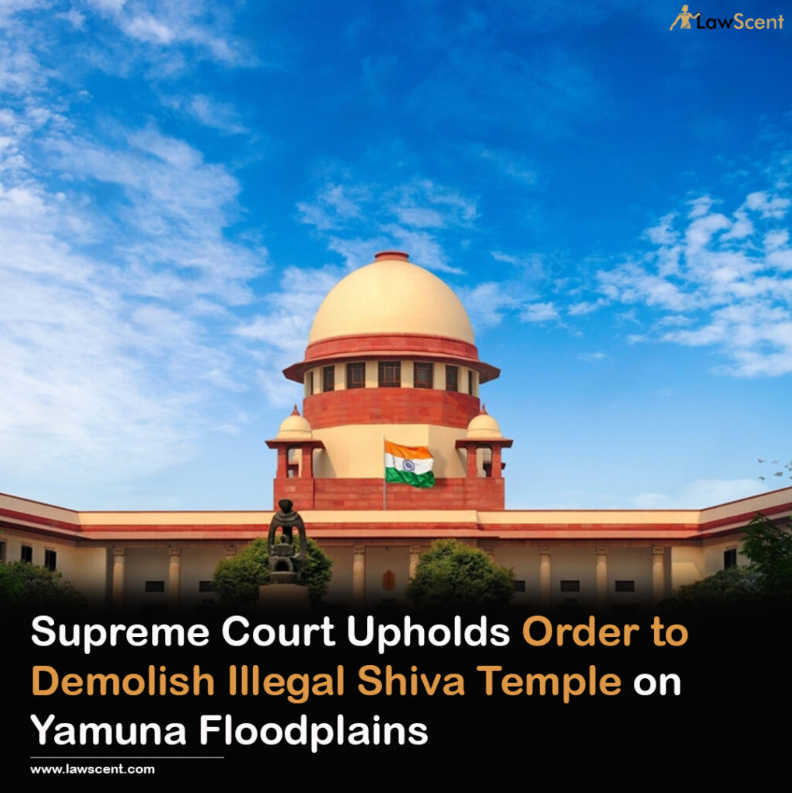
The Supreme Court has approved the demolition of an illegal Shiva Temple situated on the Yamuna floodplains. This decision upholds the May 29 ruling by the Delhi High Court, which had ordered the temple's demolition. The High Court had argued that the Yamuna riverbed and floodplain should be free from encroachments and illegal constructions, suggesting that Lord Shiva would be happier with a cleaner environment.
Supreme Court Hearing Details
A vacation bench of Justices PV Sanjay Kumar and Augustine George Masih addressed the case, confirming that the High Court's decision was sound and questioning the legitimacy of the petition filed by the Akhada Samiti.
"Justice Kumar pointed out that having an akhada (a traditional place of wrestling) on floodplains is inappropriate and noted that akhadas are typically associated with Lord Hanuman, not Lord Shiva."
Delhi High Court's Reasoning
The Delhi High Court had emphasized that Lord Shiva does not need the court's protection, but rather, it is people who seek his protection and blessings. The court dismissed the petitioner's attempt to involve Lord Shiva directly in the legal matter, labeling it as a tactic to shift the focus of the dispute.
The court stated that the real concern is the encroachment on the Yamuna floodplains, and clearing these areas would be more respectful to Lord Shiva. Justice Dharmesh Sharma of the Delhi High Court further noted that just because daily prayers and special events are held at the temple, this does not make it a place of public significance.
Legal and Environmental Grounds
There was no evidence to prove that the temple was a public entity rather than a private one managed by the petitioner society. Based on these findings, the High Court had granted the Delhi Development Authority (DDA) the right to demolish the unauthorized structure.
The petitioner society and its members were instructed not to interfere with the demolition process. The court's decision was based on:
- Environmental protection of Yamuna floodplains
- Legal precedents on encroachment violations
- Public interest in maintaining natural waterways
- Urban planning and development regulations
- Religious freedom within constitutional boundaries
Supreme Court's Final Decision
Unhappy with the High Court's ruling, the Akhada Samiti appealed to the Supreme Court, but their appeal was dismissed. The Supreme Court's decision reinforces the High Court's stance that removing illegal structures from the Yamuna floodplains is necessary for environmental and legal reasons.
Key Legal Principles Established
This ruling establishes several important legal principles:
- Environmental precedence over religious structures: Natural conservation takes priority over unauthorized constructions
- Public vs. private religious spaces: Daily worship does not automatically confer public status
- Legal boundaries of religious practice: Religious activities cannot violate environmental and urban laws
- State authority in urban planning: Government agencies can enforce demolition orders for illegal constructions
- Court's role in religious matters: Judicial review extends to religious structures that violate legal norms
Broader Environmental Implications
The decision has significant implications for environmental law and urban planning:
- Yamuna river protection: Reinforces efforts to maintain the ecological integrity of the river
- Floodplain management: Establishes precedent for protecting flood-prone areas
- Urban development regulation: Strengthens enforcement of building codes and zoning laws
- Environmental jurisprudence: Advances the "polluter pays" principle in religious contexts
- Public interest litigation: Encourages legal action for environmental protection
Religious and Cultural Considerations
The court's approach balanced religious sentiments with legal obligations:
- Acknowledged the spiritual significance of the temple to devotees
- Emphasized that Lord Shiva represents protection of natural elements
- Recognized that environmental protection aligns with religious values
- Maintained that religious practice cannot override constitutional duties
- Preserved the right to worship while requiring compliance with laws
Implementation and Enforcement
The ruling provides clear directives for implementation:
- DDA authorized to proceed with demolition
- Petitioner prohibited from interfering with the process
- Timeline for compliance to be established
- Provision for alternative worship arrangements
- Monitoring mechanism for future compliance
Precedent for Future Cases
This decision sets important precedents for similar cases involving:
- Religious structures in environmentally sensitive areas
- Encroachment on public land and water bodies
- Balancing religious freedom with environmental protection
- Urban planning in metropolitan areas
- Public interest litigation for environmental causes
Public and Legal Response
The ruling has generated various responses:
- Environmental groups: Welcomed as victory for river conservation
- Legal community: Praised for clear legal reasoning
- Religious organizations: Mixed reactions on balancing faith and law
- Urban planners: Supported for strengthening development regulations
- Public interest advocates: Viewed as model for environmental jurisprudence