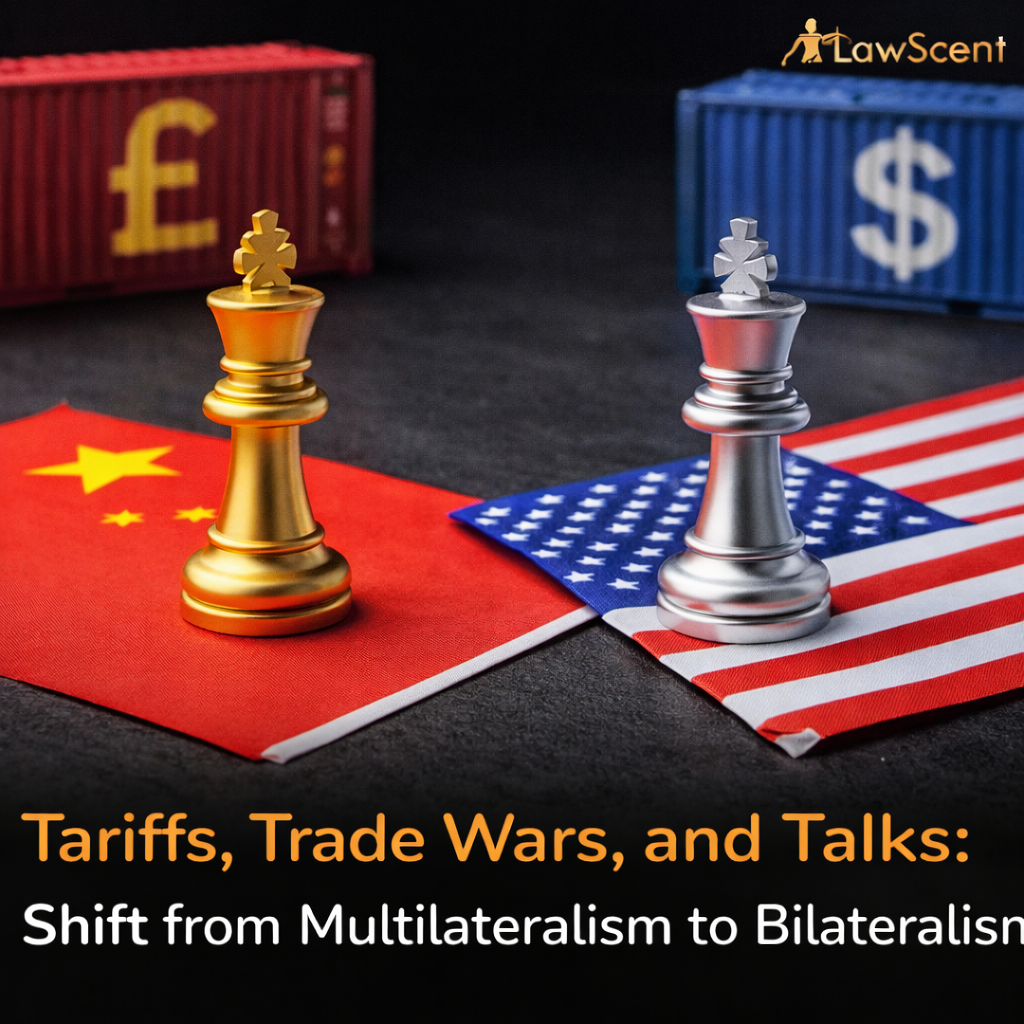
The Trump 2.0 administration's 'reciprocal' tariffs wreaked havoc on the global economy. The move not only challenged the already fragile rules-based multilateral trading system but also caused market fluctuations and fear of supply chain disruptions, triggering uncertainty across businesses. While much has been written about these tariffs, this piece focuses on the bigger problem caused by such unilateral governmental actions, which represent a shift from multilateralism to bilateralism in international trade.
This piece first discusses the international trade law implications of such tariff increases and the responses to them from other countries, while capturing the latest developments. It then examines how similar tariff increases by the Trump 1.0 administration played out in the past and highlights how the US uses tariffs to bring countries to the negotiating table, further eroding the relevance of the World Trade Organization (WTO).
Table of Contents
Reciprocal Tariffs and Responses
The announcement on 2 April 2025, dubbed 'Liberation Day' by President Donald Trump, was not the first time tariffs the US government increased tariffs citing 'national security'. This time, however, they were supposed to be 'reciprocal'. But the tariffs allotted to the countries had nothing to do with the rates applied by them on the US and were instead calculated on the basis of the goods trade deficit the countries had with it.
Economists questioned the methodology adopted for the tariffs and found flaws in the calculation. In addition to the 'reciprocal' tariffs, a base-level tariff of 10% was also applicable on all countries.
WTO Law Implications
Under WTO law, the maximum level of tariff that a country may apply on a good is referred to as the 'bound rate'. Countries agree on these bound rates after years of negotiations, and this is reflected in their Schedule of Concessions.
"Undoubtedly, Trump's reciprocal tariffs—which envisage their unilateral increase beyond the bound rates and differential application of tariffs on the same product originating from different countries—is inconsistent with WTO rules."
Bound Rates and GATT Provisions
Specifically, Article II of the General Agreement on Tariffs and Trade (GATT) 1994 mandates that a WTO member cannot raise its tariffs for a product beyond the bound rate. A country may modify it but only through a process of renegotiation under GATT Article XXVIII, which requires:
- Notification to the WTO
- Compensation to the countries most affected
- Alternate tariffs or other mutually agreed upon concessions
Most Favoured Nation Principle
Additionally, Article I of the GATT mandates that the tariff rate applied for a product be the same across all countries, known as the most favoured nation (MFN) principle. WTO members usually apply tariffs below their bound rates.
The Trump administration's approach of applying different tariff rates to the same products based on trade deficits with different countries directly violates this fundamental MFN principle, creating a discriminatory trading system.
Historical Context: Trump 1.0 Era
The Trump 1.0 administration similarly implemented sweeping tariff policies that disrupted global trade patterns:
- Steel and aluminum tariffs under Section 232 of the Trade Expansion Act
- China-specific tariffs under Section 301 investigations
- Automotive sector tariffs threatening global supply chains
- Agricultural product tariffs affecting farming communities worldwide
These measures led to retaliatory tariffs from trading partners, creating a cycle of trade conflicts that affected global economic stability.
US Negotiation Strategy
The United States has increasingly used tariffs as a negotiating tool to:
- Force trading partners to renegotiate bilateral agreements
- Extract concessions on market access and regulatory issues
- Address perceived trade imbalances through unilateral pressure
- Bypass multilateral frameworks in favor of bilateral arrangements
This approach treats international trade law as a tactical instrument rather than a binding legal framework, undermining the predictability that global commerce requires.
Erosion of WTO Relevance
The shift toward bilateralism has significantly weakened the WTO's role in several ways:
Institutional Challenges
- Paralysis of the Appellate Body due to US blocking appointments
- Reduced confidence in multilateral dispute resolution mechanisms
- Increased reliance on bilateral and regional trade agreements
- Weakening of the rules-based trading system
Legal Precedent Concerns
- Normalization of unilateral trade actions
- Precedent-setting for other nations to follow suit
- Erosion of legal certainty in international trade
- Fragmentation of global trading rules
Global Economic Impact
The tariff wars have created widespread economic disruption:
Market Uncertainty
- Volatility in global stock markets
- Disrupted supply chain planning
- Reduced business investment due to policy uncertainty
- Currency fluctuations affecting international transactions
Supply Chain Disruptions
- Rerouting of manufacturing to avoid tariff costs
- Increased logistics and compliance costs
- Just-in-time inventory system vulnerabilities
- Regionalization of supply chains at higher costs
Developing Country Impact
- Reduced export opportunities for emerging economies
- Loss of preferential trade arrangement benefits
- Increased difficulty in attracting foreign investment
- Compromised development goals due to trade barriers
Future Outlook
The trajectory of international trade law faces several critical challenges:
Potential Scenarios
- Continued Bilateralism: More countries adopting unilateral trade measures
- WTO Reform: Potential restructuring of multilateral trade governance
- Regional Integration: Increased focus on regional trade blocs
- Hybrid Approach: Combination of multilateral and bilateral frameworks
Legal Adaptation Needs
- Modernization of WTO rules for digital economy
- Enhanced enforcement mechanisms
- Better dispute resolution processes
- Improved flexibility for developing nations
Business Strategy Implications
- Need for diversified supply chain strategies
- Enhanced risk management for trade policy changes
- Greater emphasis on regulatory compliance
- Investment in alternative market development
"The fundamental challenge lies not merely in the tariffs themselves, but in what they represent: a systematic departure from the post-war consensus that international cooperation and rules-based systems serve global prosperity better than competitive nationalism and unilateral action."
Key Recommendations
For policymakers and businesses navigating this evolving landscape:
- Strengthen Multilateral Institutions: Reform rather than abandon existing frameworks
- Enhance Transparency: Clear communication of trade policy intentions
- Develop Contingency Plans: Prepare for various trade scenario outcomes
- Promote Dialogue: Encourage diplomatic solutions over economic coercion
- Balance Interests: Consider both domestic and international stakeholder impacts